
How to Mix Furniture Styles for a Cohesive NJ Home


As a family-owned business serving Northern New Jersey for over 70 years, we've learned a thing or two about creating a home that feels both beautiful and personal. The real secret to mixing furniture styles isn’t some complicated design formula—it’s about finding a common thread that ties everything together. We’ve found that focusing on a consistent color palette, a repeated wood tone, or a similar texture is the simplest way to create harmony. From our Succasunna furniture store, we've seen this simple principle work every time.
Why Should I Mix Furniture Styles Instead of Buying a Matching Set?
Mixing furniture styles allows you to create a home that tells your unique story, blending cherished pieces with new finds. It results in a warm, thoughtfully curated space that feels authentic and personal, unlike a generic room filled with a matching set from a big-box store catalog.
For decades, we’ve stepped into countless homes across Morris County and Sussex County. The ones that feel the most inviting are never the ones where every piece is a perfect match. Instead, they're the homes that blend furniture collected and loved over time.
Learning how to mix furniture styles lets you build a room that feels authentic. It’s about creating visual harmony, not rigid perfection. We see this approach resonate with so many of our neighbors:
- The Established Upgrader: You can finally invest in that beautiful Bassett traditional dining table you’ve always wanted without having to part with the mid-century modern chairs you love.
- The New Suburbanite: As you move into your first home in Roxbury Township, you can blend the modern sofa from your city apartment with rustic, family-friendly pieces that fit your new lifestyle.
What is the 80/20 Rule for Mixing Styles?
The 80/20 Rule is a simple guideline where your room is grounded with one dominant style (80%) and then layered with a secondary style through accent pieces (20%). This creates balance and personality without making the space feel chaotic or disjointed.
For example, your Morris County living room might be 80% cozy modern farmhouse, built around a large, comfortable sectional and rustic wood tables. The remaining 20% could be a sleek, industrial-style bookcase and a minimalist floor lamp. It’s that little bit of contrast that adds personality.
This method ensures every piece has a purpose and contributes to a unified, yet interesting, look. This is a far more personal approach than you'll get from online-only retailers, where you can't see how different textures and scales really feel next to each other.
If you're looking to create a more intentional space, you might find our guide on how to personalize your space without feeling overwhelmed helpful.
At Suburban Furniture, we believe your home should evolve with you. Mixing styles isn't just a design trend; it's a practical way to honor your past, embrace your present, and build a space that is uniquely yours. It’s a reflection of your family’s journey right here in Northern New Jersey.
The beauty of this approach is its flexibility. You can gradually add or swap out the 20% accent pieces as your tastes change, all without needing to overhaul the entire room. It’s an investment in a timeless design that grows right alongside your family.
How Do I Find an Anchor Piece to Define My Dominant Style?
To find your anchor piece, choose the largest or most visually significant item in the room—like a sofa, bed, or dining table. This piece should embody the primary style and feeling you want to create, serving as the foundation for all other design decisions in the room.
Every beautifully mixed room we've helped design in Northern New Jersey starts with this one key decision. Think of your anchor piece as the North Star for all your other design choices. Once you have this in place, mixing in other styles feels less like a puzzle and more like a creative journey.
How Do I Choose an Anchor Piece?
You’ll want to pick the largest, most-used item in the room that perfectly captures the main feeling you want to create. Are you going for modern, traditional, or something more rustic? This piece grounds your design and makes layering in smaller accent items from other styles feel intuitive.
For example, an "Established Upgrader" in Morris County looking to invest in timeless quality might choose a classic, American-made Bassett sofa. Its traditional lines and solid build instantly establish the room’s dominant character.
On the other hand, a "New Suburbanite" moving into their first Roxbury Township home might go for a durable, family-friendly Flexsteel sectional as their modern anchor. With its clean lines and practical design, it sets a contemporary tone perfectly suited for a busy lifestyle, especially one that has to withstand muddy NJ winters.
Your anchor piece isn't just furniture; it's the heart of the room's personality. It's the piece that says, "This is who we are." It makes every other decision simpler because you always have a strong, central theme to return to.
Identifying Your Dominant Style
Before you can choose an anchor, you need a clear vision for the style you're anchoring to. This is where many of our customers feel a little stuck, but it’s simpler than you think. You don’t have to be a design expert.
To get a feel for what you like, Your Ultimate Interior Design Styles Guide is a great resource for exploring different aesthetics. Just think about the overall vibe you want for your home.
- Do you prefer clean lines and uncluttered spaces? Your dominant style might be Modern or Mid-Century.
- Are you drawn to cozy textures and warm woods? You could lean towards Farmhouse or Rustic.
- Do you love ornate details and classic silhouettes? Traditional could be your go-to style.
This whole idea of personalizing spaces is why so many homeowners are ditching the matching furniture sets. It’s all about balancing tradition with innovation—a trend that’s taken hold globally, with the furniture market expected to hit USD 996.38 billion by 2034. Here in the U.S., a booming housing market has only fueled this creativity, with nearly 71% of new homeowners experimenting with eclectic mixes to make their homes truly their own.
If you’re still trying to pin down your anchor, our guide on how to choose the perfect sofa can help you think through the most important factors for what is often a room's most significant piece.
Once you’ve settled on your anchor, the rest of the room starts to fall into place. That traditional sofa suddenly looks amazing with an industrial-style metal coffee table. The modern sectional is beautifully softened by a rustic, reclaimed wood console. It all comes back to creating that perfect 80/20 balance, and it all starts right here.
How Can I Use Color to Unify Different Furniture Styles?
A consistent color palette is the most effective tool for creating cohesion among different furniture styles. By choosing a primary, secondary, and accent color and repeating them throughout the room, you create a visual thread that ties everything together, making the space feel harmonious and intentional.
Once you've picked your anchor piece, color becomes your best friend. A consistent color story is what makes a modern sofa, a traditional rug, and an industrial coffee table feel like they were always meant to be in the same room.
For over 70 years, we’ve been helping families right here in Succasunna and across Morris County find that perfect balance. We usually start with a simple but incredibly effective technique.
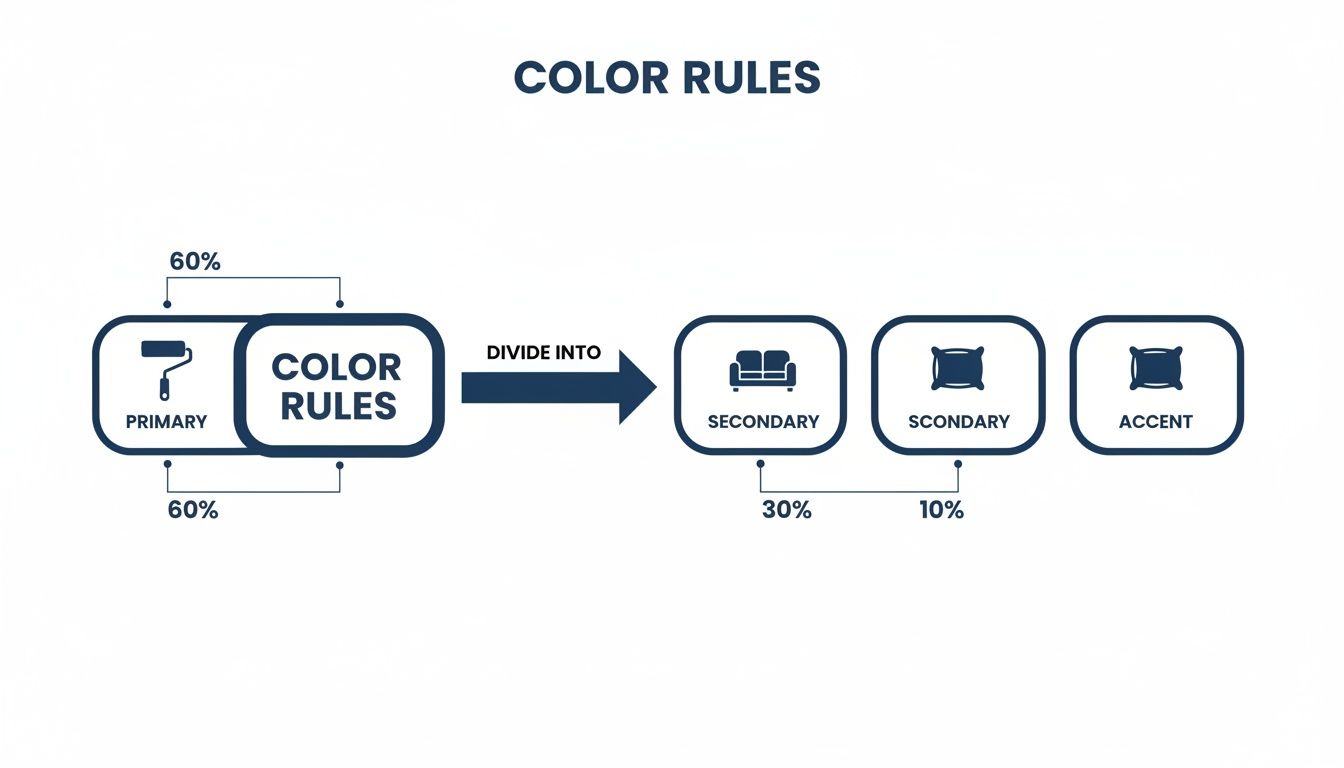
What is the Rule of Three for Color?
The "Rule of Three" is a straightforward design principle for creating a balanced color palette. You choose a primary color for the largest surfaces like walls (about 60% of the room), a secondary color for large furniture pieces (30%), and a third accent color for smaller decor items (10%).
This framework gives you just enough structure to keep a mixed-style room from feeling visually scattered. You can easily pull these shades from a favorite rug, a piece of artwork, or even the view from your window to build a palette that feels personal and cohesive.
Let’s picture a living room in Roxbury Township designed to be a cozy retreat during a long Northern New Jersey winter.
- Primary Color (60%): A soft, warm greige on the walls creates a welcoming backdrop.
- Secondary Color (30%): A deep navy blue for a large, comfortable sectional provides a strong, grounding element.
- Accent Color (10%): Pops of burnt orange in pillows, a throw blanket, and a vase add warmth and visual punch.
With this method, a sleek mid-century media console and a rustic farmhouse-style coffee table can coexist beautifully because they both tie back into that unified color scheme.
Customizing Your Color Story
This is where working with a local, family-owned store makes a world of difference compared to a big-box chain or an online-only retailer. Our Custom Solutions pillar was designed for exactly this. You’re never limited to a few pre-selected fabrics that are almost right.
At Suburban Furniture, we believe color is too important to compromise on. When you can customize the fabric of your main furniture pieces, you gain complete control over your room's color story, ensuring a perfectly harmonious look.
Bring us a paint swatch, a fabric sample, or even just a photo you love. We can help you customize a La-Z-Boy chair, a Craftmaster sofa, or an England Furniture sectional in the exact hue to complete your vision. This level of personalization ensures your anchor and secondary pieces fit seamlessly into your chosen palette—a service online sellers with their limited stock simply can't match. You can learn more by checking out our expert's guide to the perfect color palette for more in-depth tips.
Tying It All Together with Neutrals
If you’re a little nervous about committing to bold colors, just start with a neutral base. Shades of white, beige, gray, and tan are incredibly forgiving and act as the perfect canvas for mixing styles. A neutral palette actually lets the different shapes and silhouettes of your furniture—the graceful curve of a traditional armchair versus the clean lines of a modern table—really stand out.
You can then layer in color through things that are easy to change, like textiles and art. This approach is especially popular with the "New Suburbanite" families we see in Sussex County who want a timeless foundation that can evolve as their tastes and family grow. By focusing on a unifying color palette, you give yourself the freedom to mix furniture styles with confidence, knowing the final result will feel both personal and polished.
What Are Some Proven Style Pairings That Work?
Some of the most successful style pairings include Mid-Century Modern with Modern Farmhouse, Traditional with Industrial, and Bohemian with Minimalism. These combinations work because they create a beautiful balance—one style's strengths complement the other's, resulting in a cohesive and visually interesting space.
Seeing is believing, right? To make the idea of mixing styles less abstract, let's walk through some go-to pairings we see working beautifully in homes all across Northern New Jersey. These combinations prove that with a little thought, you can create a look that’s both cohesive and brimming with personality.
From Roxbury Township to the far corners of Sussex County, our customers are getting more creative than ever. And it makes sense—the global home decor market is projected to grow from USD 243.9 billion in 2025 to USD 432.2 billion by 2035, with a whopping 55% of sales involving these hybrid aesthetics. People want spaces that tell their own unique story.
Here are a few tried-and-true style combinations that create magic every time.
| Style Combination | Why It Creates Harmony | Example Furniture Pairing |
|---|---|---|
| Mid-Century Modern + Modern Farmhouse | The clean, minimalist lines of Mid-Century design cut through the cozy, rustic warmth of Farmhouse, creating a perfect balance of uncluttered and inviting. | A solid, rustic wood dining table surrounded by sleek, iconic Mid-Century chairs. The contrast is instant sophistication. |
| Traditional + Industrial | The raw, edgy textures of Industrial (think reclaimed wood and metal) keep the timeless elegance of Traditional pieces from feeling stuffy or dated. | A classic, tufted leather sofa paired with a coffee table made of raw metal and reclaimed wood. It's a beautiful dialogue between soft and rugged. |
| Bohemian + Minimalism | The clean, neutral canvas of Minimalism prevents the eclectic, layered nature of Boho from feeling chaotic, while Boho adds soul and warmth to the minimalist base. | A simple, neutral-toned sofa layered with textured, patterned pillows, a handwoven rug, and plenty of greenery in artisanal planters. |
These are just starting points, of course. The real fun begins when you start experimenting with pieces you love and find new ways to make them work together.
The Power of a Unifying Color Palette
No matter what styles you’re mixing, a disciplined color palette is the glue that holds everything together. It provides the structure needed for different aesthetics to coexist without clashing. It’s what makes a space feel intentionally designed, not just randomly thrown together. You can dive deeper into the nuances between different looks in our article comparing contemporary vs traditional design styles.
Case Study: Boho Meets Minimalism
This pairing is perfect for anyone wanting a space that feels both serene and soulful. The key is to let Minimalism provide a clean, uncluttered canvas, which keeps the vibrant, eclectic nature of Bohemian decor from becoming overwhelming. In turn, Boho adds warmth, texture, and personality that a purely minimalist room might lack.
Start with a simple, neutral-colored sofa with clean lines. Then, layer in the Boho elements:
- Textured pillows in a mix of patterns and materials.
- A handwoven rug with a bold, colorful design.
- Lots of greenery in unique, artisanal planters.
- Wicker or rattan accent pieces, like a side chair or a pendant light.
For a great real-world example, take a look at how to create a minimalist modern boho living room. You’ll see how it expertly blends clean lines with eclectic, personal touches, allowing treasured items to shine without creating clutter.
Our Pro Tip: When mixing these two styles, let your larger, foundational items (sofa, media console) be minimalist. Then, use the more vibrant, eclectic Boho pieces as your accents. This ensures the room feels peaceful and grounded, not chaotic.
The best part about mixing styles is that you can often start with what you already own. And if you find that one perfect accent chair to complete your look, our In-Stock Availability means you won't have to wait weeks for it. We can often schedule our White Glove Delivery service right away—a level of convenience you just won’t find with online-only retailers.
What Common Mistakes Should I Avoid When Mixing Furniture Styles?
The most common mistakes are ignoring scale and proportion, using too many "statement" pieces that compete for attention, and forgetting to include a unifying element like a consistent color or material. Avoiding these pitfalls is key to creating a space that feels curated and harmonious, not cluttered or random.
Over our family's 70+ years of helping neighbors furnish their homes in Succasunna, Roxbury Township, and across Northern New Jersey, we've learned that the small details make all the difference. Knowing how to mix furniture styles is as much about avoiding common pitfalls as it is about picking the right pieces.
Are You Ignoring Scale and Proportion?
This is, without a doubt, the most frequent mistake we see. Getting the scale right ensures that furniture pieces look balanced and harmonious together, preventing one item from visually swallowing another. Without it, a room can feel awkward and uncomfortable, no matter how stylish the individual pieces are.
Picture a tiny, delicate loveseat placed next to a massive, overstuffed armchair. Each piece might be beautiful on its own, but together, the scale is completely wrong. This is especially true in many Morris County homes, which feature a mix of cozy, older layouts and spacious new constructions.
Do You Have Too Many 'Star Players'?
Every room needs a focal point, but having too many "statement" pieces just creates visual chaos. When multiple bold, eye-catching items compete for attention, the eye has nowhere to rest, making the space feel cluttered and busy.
Think of your room's design like a conversation. You need a main speaker (your anchor piece) and supporting voices (your accent furniture). If every piece is shouting for attention, the result is noise, not harmony.
Our 5-Star Formula was built to help you avoid these very issues. It starts with expert, neighborly advice to help you plan your space and ends with our White Glove Delivery, where our team ensures every piece is placed perfectly. It’s a level of Real Person Support that contrasts sharply with the curbside drop-offs from online sellers.
Is There a Common Thread Missing?
The final common mistake is forgetting to weave a common thread through the room to tie everything together. Without a unifying element—like a consistent color palette, a repeated texture, or a similar material—even the most beautiful furniture can look like a random collection of items.
A shared color, even in small doses, can make a modern chair feel connected to a traditional sofa. A repeated wood tone can create a subtle sense of cohesion. This is the glue that holds your mixed-style room together.
Mixing styles has become a cornerstone of modern interior design as homeowners look to create truly personalized spaces. In fact, a 2023 survey noted that 67% of clients successfully mixed three or more styles after a design consultation, boosting their overall home satisfaction by 42%. You can discover more insights about these custom furniture market trends and see just how popular this approach has become.
Bring Your Vision to Life at Our Succasunna Showroom

Now that you have the playbook for mixing furniture styles, it’s time for the best part: bringing that vision to life. The core ideas are simple: start with a solid anchor piece, pull everything together with a color palette you love, and give yourself permission to experiment.
We’d love for you to come bridge the gap between theory and reality by visiting our showroom here in Succasunna. It’s a step you just can’t get from online-only retailers, and honestly, it makes all the difference.
Why is Visiting a Showroom Important?
Seeing and touching furniture in person is the only way to confidently feel out its scale, texture, and true color. It’s how you make sure every piece you choose will actually work together in your home, removing the guesswork that comes with screen shopping. We've all been there—the color that looked one way online shows up completely different in your living room light.
In our Morris County showroom, you can actually "test drive" a La-Z-Boy recliner for comfort, feel the difference between performance fabrics, and see how a dark walnut finish looks next to a lighter oak. It's the best way to choose pieces that will stand the test of time, both in style and durability.
For over 70 years, our family has believed the best design decisions are made when you can experience the furniture firsthand. It’s about building a home you love, piece by piece, with confidence.
As a local, family-owned furniture store, we’re deeply committed to helping our neighbors in Roxbury Township, Sussex County, and across Northern New Jersey build homes they’re proud of. Our complimentary Design Consultants are always here to help you pull it all together. They can offer a second opinion, help you visualize your space, and ensure your final selections create the harmonious, curated look you've been dreaming of.
Ready to take the next step? We invite you to our showroom in Succasunna to see, touch, and test drive the furniture for yourself. You can also schedule a complimentary design appointment with one of our friendly experts to find the perfect fit for your home.
Your Questions Answered: Mixing Styles Like a Pro
Over the years in our showroom, we’ve heard just about every design question imaginable from homeowners across Sussex and Morris Counties. Here are a few of the most common ones we get about mixing furniture styles, with some quick, practical advice to help you get started.
Can I Really Mix Different Wood Tones In The Same Room?
Absolutely! Mixing wood tones is one of our favorite ways to add depth and character to a room. The key is to pick a dominant wood tone for your largest pieces, like a dining table from Hooker Furniture, and then introduce one or two other tones as accents. To keep it harmonious, stick with woods that share a similar undertone (cool, warm, or neutral).
How Many Different Furniture Styles Are Too Many?
As a rule of thumb, we recommend starting with two or three styles max. Any more than that, and the room can start to feel a bit chaotic instead of curated. Think of your dominant style as the foundation (about 70-80% of the furniture), with the other styles sprinkled in as accents. A mostly traditional Roxbury Township living room gets a fresh feel from a few well-placed industrial metal accents.
Is It Okay to Mix Metals Like Gold and Silver?
Yes, and we highly encourage it! Mixing metals is a very modern and chic design choice. The trick is to choose one metal as your primary finish and then introduce a second metal as an accent on smaller items like picture frames or a lamp base. Spread that accent metal around the room in at least three places to make the look feel intentional.
At Suburban Furniture, our family has spent over 70 years helping our neighbors in Northern New Jersey navigate these exact questions. If you’re still not sure where to start, stop by our Succasunna showroom. You can see these principles in action and get personalized advice from our complimentary Design Consultants. Visit us today and let’s create a space you’ll love.


